


Poka-Yoke (Error Proofing)
What Is Poka-Yoke?
Poka-Yoke, sometimes written as Poka Yoke (pronounced POH-kah YOH-kay), is a Lean method for preventing mistakes before they result in defects, errors, or safety incidents. Originally developed by Japanese industrial engineer Shigeo Shingo, the term translates roughly as "mistake-proofing" or "error proofing."
Rather than relying on people to remember every step perfectly, Poka-Yoke improves the process itself so that errors are either impossible to make or immediately detected before causing problems.
Good Poka-Yoke designs recognize that people are human—and that even experienced professionals occasionally make mistakes.
Why Poka-Yoke Matters
No matter how well trained employees are, mistakes will occasionally happen... People become distracted. Instructions may be misunderstood. Parts may be installed incorrectly. Steps may be skipped. Fatigue and interruptions can affect concentration.
Poka-Yoke reduces the opportunity for these human errors by designing processes that naturally guide people toward the correct action. Benefits include:
-
Fewer defects
-
Improved quality
-
Reduced rework
-
Increased safety
-
Higher customer satisfaction
-
Lower costs
-
Greater process consistency
-
Increased employee confidence
The best quality systems prevent problems rather than correcting them later.
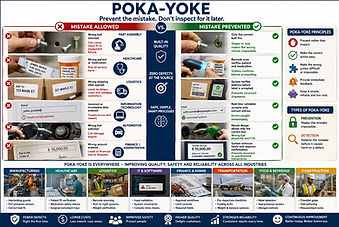
When to Use Poka Yoke
Poka-Yoke can be applied anywhere mistakes have consequences, including:
-
Manufacturing assembly
-
Healthcare procedures
-
Laboratories
-
Warehousing and logistics
-
Aviation
-
Food production
-
Construction
-
Software development
-
Administrative processes
-
Customer service
-
Everyday consumer products
Whenever people perform repetitive tasks or critical activities, error proofing can improve reliability. A quick search of your home or apartment will reveal many examples of mistake-proofing in action, many of which you take for granted simply because... they are effective and do their job!
How Poka-Yoke Works
Poka-Yoke devices and methods help ensure work is completed correctly the first time.
Prevention: Make the mistake impossible. Examples include...
-
USB connectors designed to fit only one way
-
Automotive fuel nozzles that prevent the wrong fuel from being dispensed
-
Surgical instruments or medical connectors that only attach correctly
-
Online forms that prevent submission until all required information is entered
Detection: Allow the process to stop or alert the operator before a defect continues. Examples include...
-
Barcode scanning to verify the correct patient before administering medication
-
Warehouse barcode systems confirming the correct product is picked for shipment
-
Machine sensors detecting missing or incorrectly assembled components
-
Software validation messages identifying incomplete or invalid data before submission
The goal is always the same: Prevent defects—not simply inspect for them later.
Key Concepts in Poka-Yoke
You can find examples of error-proofing and Poka-Yoke everywhere... some of it not obvious but working quietly in the background to prevent or detect mistakes. Here are some of the terms and distinguishing features of Poka-Yoke:
Prevention Over Detection: The most effective error proofing prevents mistakes entirely.
Simplicity: The best Poka-Yoke solutions are often surprisingly simple.
Human-Centered Design: Processes should accommodate normal human behaviour rather than expecting perfection.
Immediate Feedback: When mistakes cannot be prevented, they should be identified immediately.
Built-In Quality: Quality should be created during the process—not inspected in afterwards.
Continuous Improvement: Many small error-proofing improvements often produce significant long-term results.
Common Pitfalls to Avoid
Poka-Yoke is often misunderstood. Common mistakes include:
-
Adding unnecessary complexity
-
Confusing inspection with prevention
-
Blaming employees instead of improving processes
-
Ignoring human factors
-
Creating solutions that slow the process unnecessarily
-
Overlooking low-cost improvements
-
Assuming additional training alone eliminates mistakes
The most effective Poka-Yoke solutions are simple, reliable, inexpensive, and easy to maintain.
Where Poka-Yoke Fits in Lean Six Sigma
Poka-Yoke supports both Lean and Six Sigma by reducing process variation and preventing defects at the source. It works particularly well alongside:
-
5S (aka "6S")
-
Standard Work
-
Visual Workplace
-
Visual Management
-
Root Cause Analysis
-
FMEA
-
DMAIC Improve Phase
-
Kaizen
-
Total Productive Maintenance (TPM)
-
Control Plans
Together, these methods help organizations build quality directly into their processes rather than relying on inspection to find mistakes later.
What is Poka-Yoke in Simple Terms?
Poka-Yoke is the practice of designing products, equipment, or processes so that mistakes are prevented—or immediately detected—before they become defects.
Related Tools and Methods
Related Lean Six Sigma tools and concepts include:
- Root Cause Analysis
-
Control Plans
-
Total Productive Maintenance (TPM)
-
Risk Assessments
Ready to Go Beyond the Basics?
If you're ready to move from understanding concepts to applying them:
👉 Explore our full Lean Six Sigma learning paths
👉 Start building real-world improvement skills today
👉 Access over 1,000 courses with an RPM Platinum membership