


Logic, Spock, and the Curious State of Human Affairs
January 14, 2026 is World Logic Day, established by UNESCO with the aim of "fostering international cooperation, promoting the development of logic, in both research and teaching, supporting the activities of associations, universities and other institutions involved with logic, and enhancing public understanding of logic and its implications for science, technology and innovation".
The timing feels… ironic.
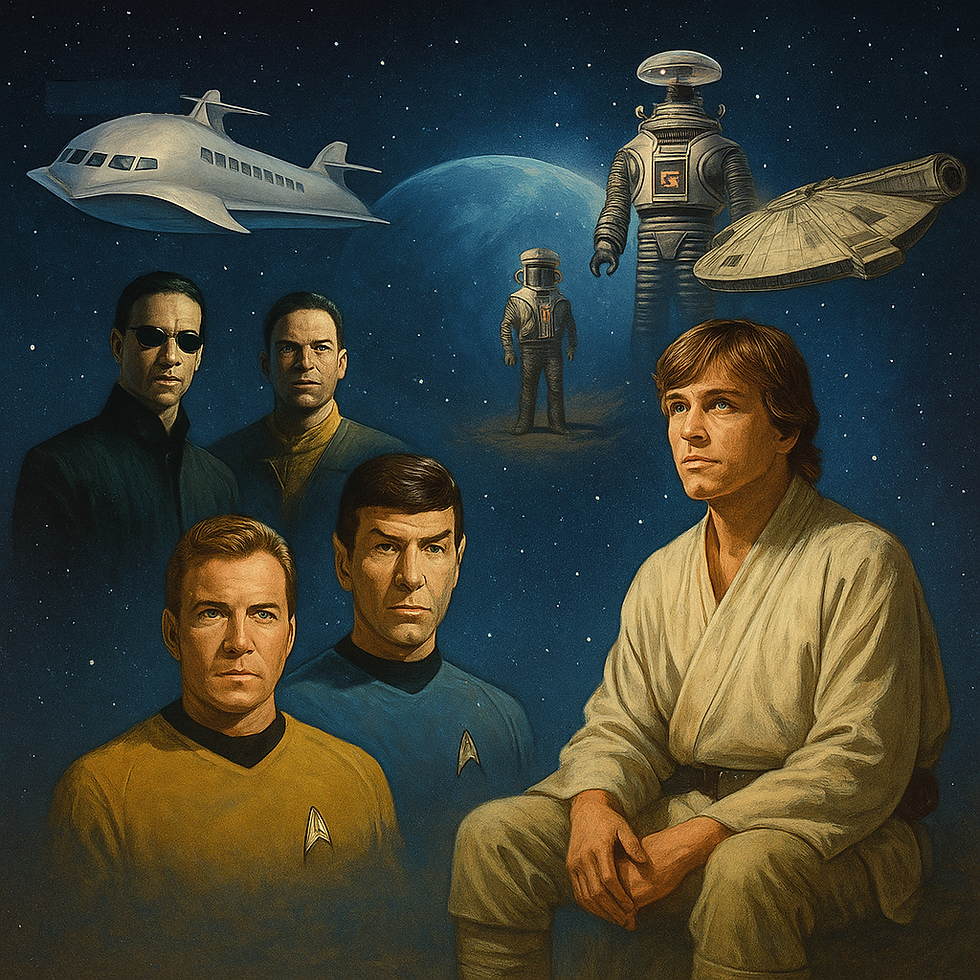
In a world that often feels "illogicalier" by the day (a perfectly acceptable word, given the circumstances), we pause to celebrate logic... that calm, disciplined way of thinking we admire deeply and practice far less frequently. And if we are to speak of characters and logic, one immediately comes to mind... 🖖 Mr. Spock.

For generations of Star Trek fans, Spock embodied logic in its purest form: rational, precise, unemotional. When humans panicked, Spock calculated. When emotions flared, he calmly reminded us that “the needs of the many outweigh the needs of the few”.
Spock became our cultural shorthand for logic. And yet, even Spock’s story reminds us that logic alone is not the full story.
What Is Logic, Anyway?
The word logic traces its roots back to ancient Greece, to the concept of logos, meaning word, reason, or reason.
Polymath Aristotle, ancient Greek philosopher and scientist who was one of the greatest intellectual figures of Western history is often called the father of formal logic. In that capacity, Aristotle wasn’t trying to teach people what to think... He was trying to understand how correct reasoning works... How conclusions follow (or fail to follow) from premises.
At its core, logic is not certainty. Logic is structure. It is the discipline that helps us distinguish:
evidence from opinion
correlation from causation
belief from proof
Logic doesn’t promise truth. It promises coherence. And coherence matters, especially when the world feels anything but.
The Evolution of Logic
Logic didn’t stop with Aristotle. Over centuries, it evolved alongside humanity’s understanding of the world:
Classical logic gave way to scientific reasoning
Enlightenment thinkers refined logic into systems of inquiry and skepticism
Modern logic expanded to include probability, statistics, and systems thinking

Today, logic underpins everything from medicine and engineering to economics and quality improvement. And yet… It now seems we live in an age of:
instant opinions
algorithmic outrage
emotionally charged certainty delivered at the speed of a swipe
Ironically, it seems we have more information than ever, and less patience for reasoning. Logic didn’t disappear. It was simply outpaced.
Spock’s Blind Spot
Spock’s brilliance was never in question. His struggle, and the reason, I think, he remains such a compelling character in the Star Trek franchise, was that logic alone was insufficient for understanding humans.
Emotion, bias, identity, fear... these aren’t bugs in human reasoning. They’re features. Ignoring them doesn’t make logic stronger; it makes it brittle. Spock’s journey was not about abandoning logic. It was about integrating it with empathy, context, and judgment.
That lesson matters today, more than ever, because many of our modern “illogical” moments are not caused by a lack of intelligence, but by unexamined thinking.
Why the World Feels "Illogicalier"
If the world feels less logical lately, it’s not because logic stopped working. It’s because:
People often use reasoning to defend their group identity, rather than to discover what is true. The "us" and "them" mentality.
Modern systems reward how fast we react, not how well we think — When speed becomes the measure of competence and reflection begins to look like inefficiency.
We tend to praise people who sound confident, even when they haven’t thought deeply, and overlook or even chastise those who ask careful questions.

The practice of logic is the application of systematic methods and principles to distinguish correct or sound reasoning from incorrect or fallacious reasoning.
In uncertain times, logic doesn’t shout... it waits, patiently, but only for those willing to engage it.
Why Learning to Think Logically Still Matters
Logical thinking is not an academic exercise. It’s a life skill. Logic shapes:
how we make decisions
how we solve problems
how we evaluate claims
how we lead
how we disagree without dehumanizing
Critical thinking begins with logic, but it doesn’t end there. It asks us to examine assumptions, question narratives, and notice when emotion is steering the wheel. This is why logic must be learned, practiced, and revisited... definitely not assumed.
A Very Un-Spock-Like Conclusion
Spock once said, “Logic is the beginning of wisdom, not the end.” ("Star Trek VI: The Undiscovered Country").
On World Logic Day, that may be the most logical takeaway of all.
Logic is not about being right. It is about being responsible with our thinking.
In a world that feels increasingly illogicalier, choosing to think clearly, patiently, and critically may be one of the most human acts we have left. In fact... our very survival as a species may depend on it.
Live long and reason.🖖


Comments