


What If Time Isn’t What We Think It Is?
Updated: Feb 15
Most of us believe we understand time... We measure it in seconds, minutes, hours, days. We schedule it. We complain about not having enough of it. We celebrate when it “flies by” and dread when it “drags on.”
But what if we’ve misunderstood it completely? What if time, as we experience it, is not a clock measurement at all… What if it’s a measure of information density?
The Clue Hiding in Everyday Life
You’ve experienced this:
A demanding workday “flies by”
A relaxing beach vacation “flies by”
Waiting in a doctor’s office feels endless
A whole week of scrolling social media disappears from memory

Why? Clock time didn’t change... But your experience did.
"By studying how primates mentally measure time, scientists at MIT’s McGovern Institute have discovered that the brain runs an internal clock whose speed is set by prior experience. In new experiences, the brain closely tracks how elapsed time intervals differ from its preset expectation—indicating that for the brain, time is relative." —
Albert Einstein Was Right… But Not in the Way We Think
Einstein quipped that, "The only purpose of time is to prevent everything from happening at once". In the article, "Special Relativity Explained", it states that, "One of the many implications of Einstein's special relativity work is that time moves relative to the observer." — Source: Space.com

Time is not fixed... But there’s another form of relativity happening much closer to home: psychological relativity. In the context of time, this refers to the subjective, variable perception of time's passage, which often deviates from objective, chronological time (measured in seconds/minutes). This phenomenon suggests that, similar to Einstein’s physical relativity, time is not an absolute experience, but rather a construct shaped by cognitive, emotional, and neural factors. Time, for humans, is elastic;
Two hours in a meeting can feel longer than two hours with friends.
A year filled with novelty feels shorter in hindsight than a year of repetition.
The Philosopher Who Saw This Coming — Henri Bergson
Bergson argued over a century ago that lived time (what he called duration) is completely different from clock time. In his doctoral thesis was on "Time and Free Will: An Essay on the Immediate Data of Consciousness" (1889), Bergson distinguished between time as we actually experience it, lived time, which he called ‘real duration’ (durée réelle), and the mechanistic time of science. — Source: Philosophy Now
We don’t experience seconds ticking. We experience continuous flows of perception, thought, memory, and sensation. Sound familiar? The flow and density of information.
The Dubai Effect: More Than Just a Feeling
"Dubai is a city of motion. Towers rise overnight, events change weekly, restaurants flip menus monthly. In a place where innovation is a daily ritual and the skyline never sleeps, your environment is set to maximum stimulation. According to neuroscientist David Eagleman, our brain uses fewer memory markers when experiences are routine or over-familiar. In contrast, when the brain is bombarded with new, stimulating input, it processes time differently—especially in dynamic places like Dubai.
Translation? In the moment, Dubai can feel busy, chaotic, and hyper-present. But in hindsight, time seems to have vanished. Why? Because your brain didn’t save enough unique memory timestamps to stretch the experience." — Source: Whatshotinuae
Eagleman’s research shows that the brain edits time based on:
novelty
attention
emotional engagement
sensory input
High novelty and engagement = high information density.
And when we look back, those periods feel short because they were rich. Low novelty (scrolling, waiting, routine) equates to low information density. And those periods feel long while happening, but nearly vanish in memory.
The Physicist Who Questions Whether Time Even Exists — Carlo Rovelli
"What does 'now' mean?... Do we experience the same 'now'?" Rovelli, in this one hour thought-provoking lecture, poses these very questions. You can view this engaging lecture at https://www.youtube.com/watch?v=-6rWqJhDv7M).
Rovelli suggests time may not be fundamental to reality at all. What may be fundamental? Information. Relationships. Change. This sounds suspiciously like how humans actually experience life.
A Detour Through Black Holes — Stephen Hawking and the Information Paradox
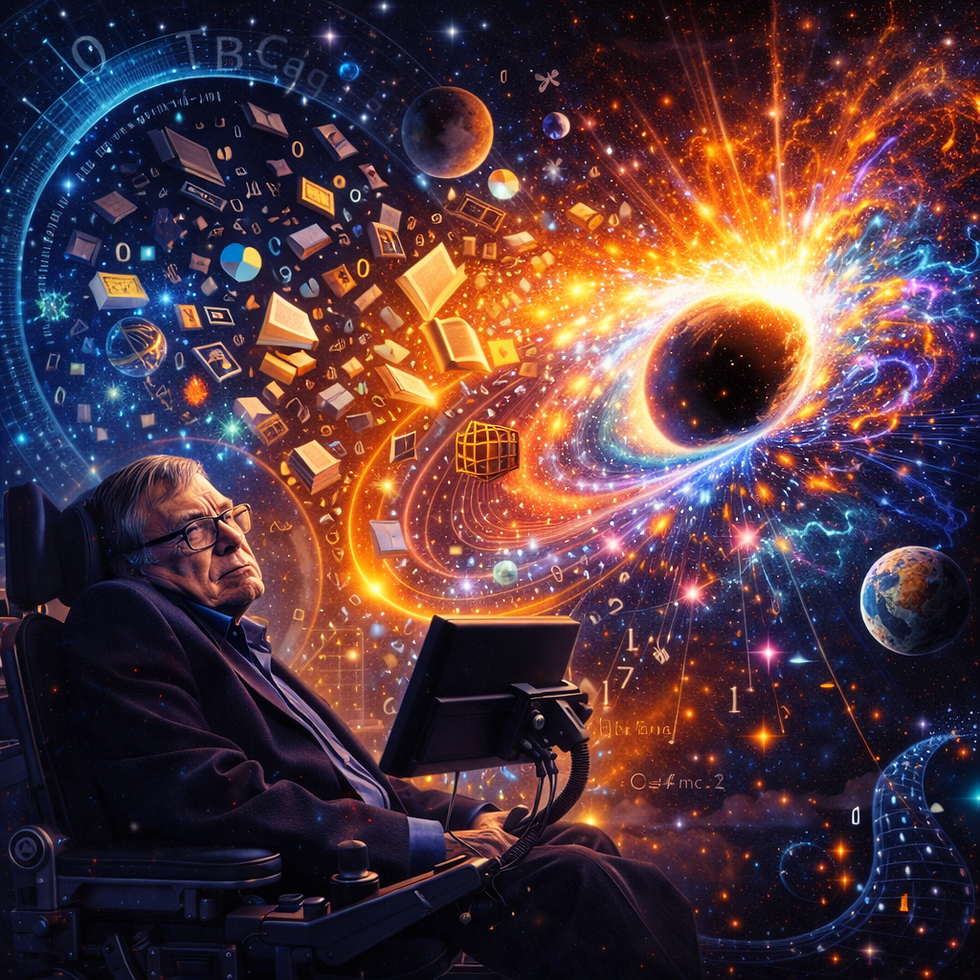
Stephen Hawking proposed that time is deeply intertwined with the universe's structure, suggesting it did not exist before the Big Bang but emerged with it... that the universe is not "in" time, but rather with time. Quantum mechanics strictly forbids the destruction of information.
Hawking eventually reconciled his work with this principle by realizing that information is preserved — Information swallowed by a black hole is not lost — it is somehow stored or scrambled.
Physics, at its deepest level, seems to care more about information than about time (or our concept of it).
So What If We’ve Had It Backwards?
What if humans don’t live inside time… What if we live inside streams of information and interpret that as time? Your senses take in and you process information:
sight
sound
touch
smell
thought
memory
emotion
The richer and denser that stream, the faster time appears to pass.
A Different Way to Measure a Day
Instead of asking: “Where did the time go today?”
What if we asked: “How dense was today with meaningful experience?”
Because that’s what you’ll remember. That’s what will make the day feel full. That’s what will make life feel rich.
Why This Matters
This reframes how we think about learning, curiosity, attention, distraction, and how we spend our days.
High information density activities | Low information density activities |
learning something new | mindless scrolling |
meaningful conversation | passive consumption |
creativity | repetition without thought |
deep focus | |
exploration |
High information density makes life feel full, while low information density makes months disappear.
A Thought to Leave You With
Maybe we shouldn’t be trying to “manage our time.” Maybe we should be trying to increase the density of meaningful information in our lives.
Because in the end… You don’t remember how much time passed. You remember what filled it.


Comments