


Learning in the Age of Intelligent Machines – Part 3 of 3
The Return of Craftsmanship: Why Human Excellence Matters More Than Ever
Part 1 of this series: "The Illusion of Knowing & Future of Learning"
Part 2 of this series: "From Just-in-Case Knowledge to Just-in-Time Capability"
For centuries, knowledge was one of humanity's greatest competitive advantages.
Those who knew more often achieved more. Education rewarded memory. Experience accumulated over decades. Expertise was earned through years of study and practice. Today, that equation is changing.
Artificial intelligence can summarize research in seconds, generate software code, analyze complex data, draft business plans, and answer questions that once required years of specialized study. Information has become abundant, accessible, and almost instantaneous.
Yet as intelligent machines become increasingly capable of producing answers, an unexpected question emerges... What makes human work exceptional?
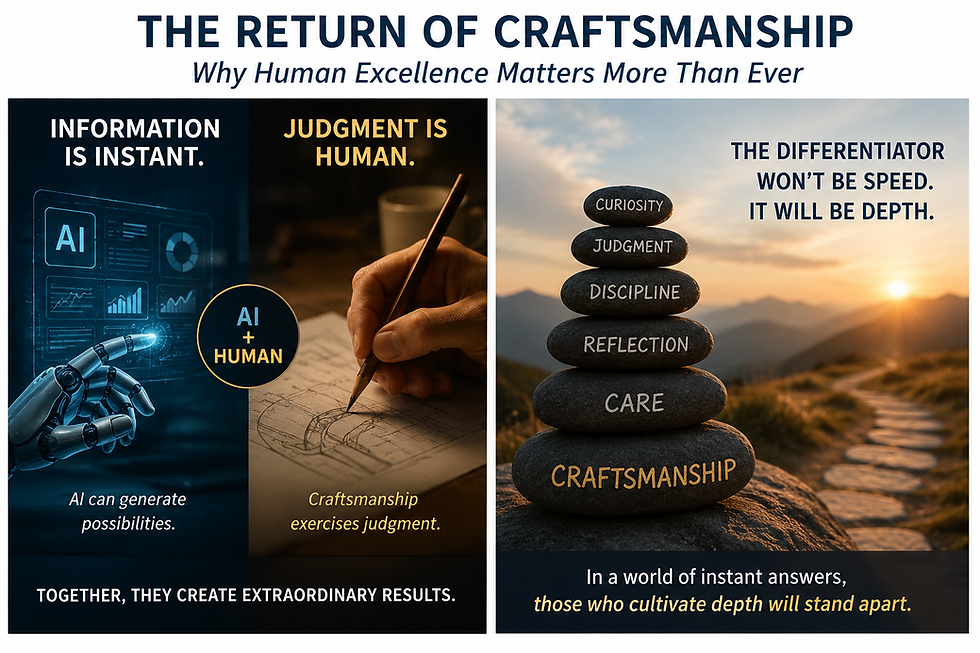
The answer, I believe, is craftsmanship. Not craftsmanship in the traditional sense of woodworking or handcrafted products, but craftsmanship as a way of thinking and working.
It is the decision to care deeply about the quality of what we create.
It is choosing understanding over assumption.
Curiosity over certainty.
Reflection over reaction.
Improvement over complacency.
Craftsmanship is not defined by the tools we use. It is revealed by the care, discipline, and judgment we bring to our work. Whether we teach, design, lead, manufacture, analyze data, coach a team, or improve a process, craftsmanship is the quiet pursuit of excellence when "good enough" would be easier.
In many ways, Lean thinking has always been an expression of craftsmanship. Lean is often associated with eliminating waste, improving flow, and increasing efficiency. While those outcomes are important, they are not the foundation of Lean. The true foundation is respect. Respect for people. Respect for the customer. Respect for the work. Respect for learning.
Continuous improvement begins with the humility to believe that today's best process can become tomorrow's better process. That mindset is craftsmanship in action. As artificial intelligence becomes more capable, this way of thinking becomes even more valuable.
AI can generate possibilities... Craftsmanship exercises judgment.
AI can summarize information... Craftsmanship asks better questions.
AI can accelerate execution... Craftsmanship determines what is worth executing.
AI can imitate experience... Craftsmanship is built through experience.
This distinction matters because the future of work will not be defined by those who can simply access information faster than everyone else. Intelligent machines have already changed that equation. Instead, the future will belong to people who know how to interpret information thoughtfully, challenge assumptions respectfully, collaborate effectively, and apply sound judgment in situations where the answer is not immediately obvious.
These are deeply human capabilities. They cannot be downloaded. They cannot be memorized. They are developed through deliberate practice, reflection, curiosity, and experience.
This is why the future of learning is about far more than technology. Learning is no longer the accumulation of knowledge for some uncertain day in the future. Learning is becoming the continuous development of human capability. Knowledge remains important, but capability creates value.
As organizations embrace AI, digital transformation, and increasingly intelligent systems, their greatest competitive advantage will not simply be the technology they deploy... It will be the people who know how to use that technology wisely.

Organizations that cultivate craftsmanship will build cultures where people think critically, solve problems collaboratively, improve continuously, and never stop learning. These are the organizations that will adapt more quickly, innovate more consistently, and create value more sustainably.
In the end, the future of learning isn't really about machines. It's about people... people who:
remain curious when answers are easy.
ask thoughtful questions before accepting convenient ones.
pursue understanding instead of simply collecting information.
choose excellence—not because someone is watching, but because craftsmanship has become part of who they are.
The age of intelligent machines does not diminish the importance of being human. It elevates it. For generations, education rewarded those who could remember the most. Tomorrow will reward those who can understand the deepest.
As intelligent machines become increasingly capable of producing answers, our greatest advantage will not be how much information we possess, but how thoughtfully we apply it. The future belongs to people who remain curious... Who seek understanding before certainty... Who improve not because they have to, but because craftsmanship is part of who they are.
Technology may transform the way we work. But it is craftsmanship that will determine the quality of what we leave behind.
Continue Your Capability Journey
If these ideas resonate with you, your journey doesn't have to end here. RPM-Academy's Platinum Learning Portal provides complimentary access to a growing collection of courses, articles, learning resources, and practical tools designed to help you build the capabilities that matter most in a rapidly changing world.
Whether you're developing your leadership skills, strengthening your problem-solving ability, exploring Lean thinking, or learning how to work more effectively alongside intelligent technologies, you'll find resources created to support continuous growth—at your own pace.
Create your free Platinum account today and begin building the capabilities that will help you navigate tomorrow with confidence.
Because the future belongs not to those who know the most, but to those who never stop learning.


Comments